


Financial services is at an inflection point. The infrastructure for open finance exists, the regulatory pressure is building, and customer expectations are already ahead of where most institutions are. The gap between those who treat open finance as a strategic priority and those who are still watching from the sidelines is beginning to show.
A theme worth examining has emerged across the industry: while it's encouraging to see banks and financial service providers building APIs and standing up open finance programs, the real challenge is that all participants in the ecosystem need to adopt this. Leaving a gap open with even one provider creates an exploit that can be leveraged. The whole chain matters, from the largest banks to the smallest credit unions.
That's the nature of an ecosystem challenge. It's not any single institution's problem in isolation. It's a collective one.
And the direction is clear: open finance is no longer theoretical. Per recent research from Akoya and American Banker , 70% of banks identified open finance as a strategic initiative. The market has spoken. The question now isn't whether to pursue open finance. It's how.
The two-sided reality
Akoya sits in a unique position in this ecosystem, working with both data providers and data recipients as the connective tissue between them. That vantage point reinforces something important: a two-sided network only works when both sides are engaged. Without active participation on both sides, the network stalls. Both sides need to show up, and organizations need the right partner to help get them there.
Building momentum
In a two-sided network, there's a recognizable moment when the ecosystem starts working: both sides begin to benefit from the momentum of the other. The smarter each participant works, the faster that momentum builds.
Working smarter in open finance means not rebuilding solutions to problems others have already solved. It means benefiting from the stumbles, fixes, and optimizations that have already happened, rather than experiencing them firsthand. It means avoiding pitfalls and getting value faster.
That's what the right partner brings to the table.
Finding the right partner
Not all partners are created equally. The right partner in open finance is one who understands the goal, has done it before, can move an organization efficiently from start to finish, and will provide ongoing support, not just at go-live.
A concrete example: a budgeting app's value is helping users manage expenses and hit savings goals. That's the core offering. Figuring out how to access data from 9,000+ financial institutions across the U.S. is not. That's not where competitive advantage lives. The right move is to find a data access network that has already built those connections and can handle that complexity.
The same logic applies on the provider side. A bank or credit union's business is built on trust, holding and protecting customers' money and financial lives. Becoming an API infrastructure company isn't the goal. Finding a trusted partner to open that new channel responsibly is.
What a real open finance commitment looks like
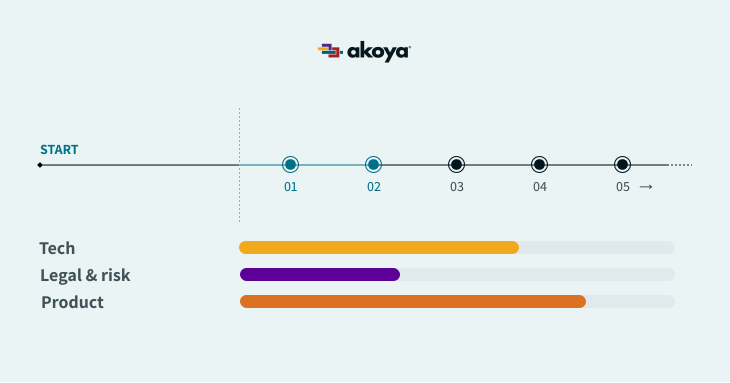
This is perhaps the most important reframe for organizations getting serious about open finance: it is a business initiative, not simply a technology project. Building APIs is foundational, but it's only part of the picture.
Open finance is a new channel for engaging with customers, as significant as digital banking or a branch network. It touches compliance, legal, risk, product, and customer experience. It requires integrations, third-party agreements, expanded risk management, and sustained performance over time. It means evolving as new products and use cases emerge, including increasingly agentic AI interactions that will require new thinking about authorization and consent.
It also means managing ongoing relationships with data recipients, the apps and tools that access customer data and serve customers on the other end. That's a relationship management challenge as much as a technical one.
Organizations that treat open finance as a strategic program and invest accordingly will be the ones that earn the trust of their customers and partners. Those that treat it as a one-time build will find themselves perpetually catching up.
Trust is the point
Customers already expect the benefits of open finance. They want their financial apps to work seamlessly. They want to control their own data. And they are counting on their financial institutions to protect their interests in the process.
Open finance isn't just an infrastructure upgrade. It's a trust proposition. And as organizations move from concept to initiative, the partner chosen to help execute it becomes an extension of that trust.
The right partner has already learned the lessons that would otherwise need to be learned the hard way. The goal is to find one that helps get the flywheel spinning faster.
Ready to move from concept to initiative? Get a custom demo to see first hand what a real open finance program looks like for your organization.
See also:
-
Whitepaper: Building a scalable framework for open finance - Akoya & American Banker
-
On-demand webinar: Turn open finance into measurable growth - Akoya & American Banker
-
Open finance assessment: Check your financial institution's readiness level
- Learn more about open finance.
.png)
.svg)
-1.svg)