

Open finance in the United States has moved from novelty to necessity for financial institutions of all sizes. What began as one-off conversations inside product and technology teams has evolved into a strategic priority showing up in board slide decks, customer experience roadmaps, and competitive strategy sessions.
This forward acceleration was the focus of a recent webinar Akoya co-hosted with American Banker and TD Bank, featuring Akoya CEO Paul LaRusso and Jo Jagadish, Head of Digital Payments and Contact Centers at TD Bank. Together, they revealed findings from a survey of 218 banking professionals and shared lessons from their own experience operationalizing open finance at scale.
Turn open finance into measurable growth
|
|
.png?width=150&height=22&name=American_Banker_logo_2011.svg%20(1).png) |
%20-%20Do%20not%20delete/Akoya-Logo-Color.svg)
This on-demand webinar, featuring industry experts from Akoya, TD Bank, and American Banker, shows how leading banks and credit unions are moving past fragmented integrations to build secure, sustainable open finance programs.
Open finance is now a board-level priority
In a live poll during the webinar, nearly 60% of attendees rated open finance as a high or critical priority for their organization today. The broader research that Akoya conducted with American Banker shows a similar trajectory, with urgency rising year over year.
According to the research and the experiences of LaRusso and Jagadish, three main forces are driving the shift:
-
Evolving customer expectations: Consumer expectations are accelerating on a J-curve, particularly with the rise of AI and agentic commerce. Customers expect financial experiences that are personalized, near real-time, and intelligent about who they are.
-
Regulatory momentum: Even without complete clarity on the CFPB’s revised 1033 rulemaking, market-led forces in the U.S. have already driven significant advancement in the open finance ecosystem, in contrast to Europe, where open finance has been regulatory-driven.
-
Changing competitive landscape: Traditional and non-traditional competitors alike are using open finance as a growth lever. Institutions that treat it as optional risk being displaced from their own customer base.
The takeaway: open finance is no longer a technology conversation. It’s a business strategy conversation.
Readiness is lagging intent, and that's the real risk
Even as most institutions recognize open finance as a priority, readiness lags intent. Only about half of surveyed institutions are in active development; the rest are still assessing opportunities or drafting strategy.
The institutions pulling ahead share a pattern. They stopped waiting for complete regulatory clarity to act. They found the strategic areas where building differentiated capability matters most, and they found partners to handle the commoditized pieces so they could keep operational expense low and deliver value early.
Ten years ago, banks had to stand up every piece of this themselves. That’s no longer the case, and institutions that recognize what to build versus what to buy move faster and spend less.
The build is bigger than the APIs
One of the most common missteps is treating open finance purely as an API build. There are distinct workstreams needed to execute at scale:
-
Technical infrastructure: APIs, connectivity, and the constant version-to-version evolution that comes with a mature digital channel.
-
Third-party oversight and risk management: Once data leaves the four walls of the institution, ongoing oversight of how it’s stored, used, and shared becomes essential.
-
Onboarding and ongoing management of third parties: With the wide range of third-party applications that consumers share data with today, this is not a one-time effort.
-
Third-party agreements: Terms, contracts, and the integration framework for how external parties access data.
Open finance today is what mobile banking was 15 years ago, and online banking was 25 years ago. It’s a third digital channel through which consumers will interact with their institution. Treating it that way reframes the investment conversation entirely.
Smaller institutions can now compete at the same level
Institutions with as little as $50 billion in assets are launching programs with feature functionality comparable to the largest global banks. The path there almost always runs through partnership.
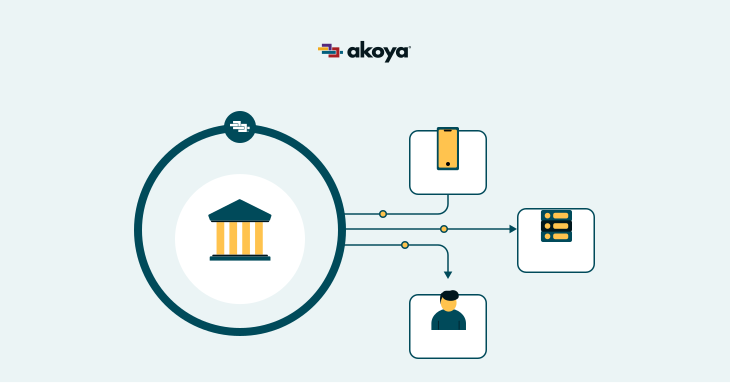
Tech platforms now handle data distribution to thousands of fintechs, data standardization, and consent management. These are capabilities that would take years and enormous investment to build in-house. The result is that community banks, credit unions, regionals, and the largest global financial institutions can now offer customers secure data transfer on the same footing.
For institutions still on the sidelines, this levels the playing field in a way that didn’t exist a decade ago.
Trust begins with consent
When surveyed institutions were asked about their biggest concerns, security, regulatory uncertainty, data liability, and legacy technology topped the list. Underneath all of them sits a single theme: trust.
Building trust at scale comes down to:
-
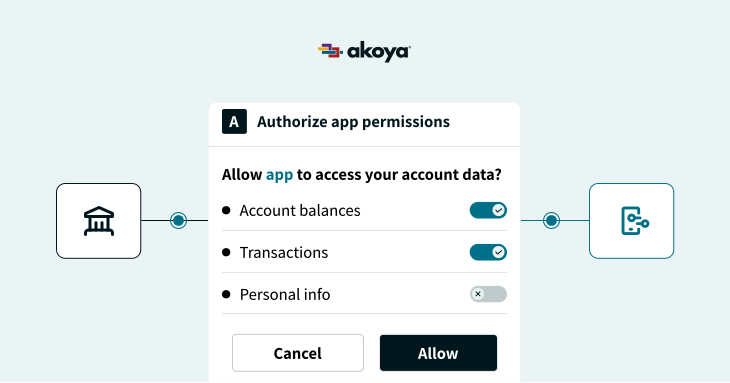
Informed consent: Consumers need to know exactly what they’re sharing, with whom, and why, with nothing hidden in terms and conditions.
-
Transparency about intermediaries: If data traverses through multiple parties, consumers need to be aware and comfortable with the full flow.
-
Ongoing visibility and control: Leading institutions are building dashboards (think of them as a security or permissions center) where consumers can see active data-sharing connections, revoke access, and manage their permissions over time.
The industry still needs clearer regulatory guidance on data liability once data leaves the banking ecosystem. But on the bank side, protecting and managing customer data remains the fundamental expression of what it means to be in the trust business.
A practical first step for the next 12 months
For financial institutions planning their next 12 to 24 months, the path forward starts with organizing around the customer. That means aligning internally on leadership and ownership and treating open finance as an added digital channel, not a technology project. From there, thinking holistically is essential.
This is not just a technical build. It's consent, third-party oversight and risk management, and the agreements that govern how data flows. And none of it has to be built alone. Mature partners in this ecosystem can meaningfully accelerate the journey without forcing institutions to reinvent the infrastructure.
The direction of travel is clear. The institutions that treat open finance as a strategic program, with a product champion, early engagement from risk and legal, and the right partners, are the ones turning it into a growth engine today.
Ready to take the next step?
Akoya partners with financial institutions of every size to deliver secure, API-based open finance infrastructure, from consent and third-party management to the connectivity layer itself.
Learn more about Akoya’s Open Finance Solution or get in touch to talk through what a practical roadmap looks like for your financial institution.
See also:
-
Whitepaper: Building a scalable framework for open finance - Akoya & American Banker
-
On-demand webinar: Turn open finance into measurable growth - Akoya & American Banker
-
Open finance assessment: Check your financial institution's readiness level
- Learn more about open finance.
-1.svg)