

_47_970x250.jpg)
Most institutions know open finance matters. Few have the infrastructure to scale it. This session, featuring industry experts from Akoya, TD Bank, and American Banker, shows how leading banks and credit unions are moving past fragmented integrations to build secure, sustainable open finance programs.
What you'll take away:
- Where open finance stands today and how institutions are converting data access into revenue
- The key factors driving adoption at scale
- What a scalable, secure open finance framework actually looks like
- Concrete next steps to build a lasting competitive advantage
Speakers
 |
 |
 |
| Paul LaRusso Chief Executive Officer |
Jo Jagadish |
Michael Moeser Senior Strategist |
 |
 |
.png?width=103&height=15&name=American_Banker_logo_2011.svg%20(1).png) |
Learn more about open finance.
See Akoya's Open Finance Solution.
Webinar transcript
Introduction & Welcome
Michael Moeser: Greetings, everyone, and welcome to today's webinar, “Open Finance at an Inflection Point: Building Scalable, Secure Data Sharing Infrastructure.” My name is Michael Moeser, and I will be your host and moderator. I'm a senior content strategist at American Banker.
Michael Moeser: Joining me today are two speakers. Our first speaker is Jo Jagadish. Jo is the Head of Digital Payments and Contact Centers at TD Bank US. In this role, Jo leads the strategy, execution, and innovation of digital and mobile capabilities to drive the future of omnichannel experiences at TD. She also serves as a member of the US Senior Executive Team. Before joining TD, Jo held executive roles at JPMorgan Chase and Citi. She holds a bachelor's from VTU and is a 2024 honoree of American Banker's Most Powerful Women in Banking.
Michael Moeser: I'm also joined by Paul LaRusso. Paul is a seasoned banking executive who has served as Chief Executive Officer at Akoya for over three years. Prior to that, he spent 15 years at JPMorgan Chase as Managing Director and Head of Open Banking, with additional roles at Verizon and T-Mobile. Paul holds an MBA from Georgetown University's McDonough School of Business and a bachelor's degree from Bucknell University. Welcome, Jo and Paul.
Paul LaRusso: Hi Michael. Nice to be here.
Jo Jagadish: Great to see you all.
Research Overview and Opening Poll
Michael Moeser: Let's start with the research that we'll be sharing as the basis for today's discussion. We recently conducted a survey of 218 qualified respondents. To qualify, respondents had to work at a financial institution and have significant knowledge of at least one of the following: customer data sharing APIs, third-party partnerships, customer experience, or digital strategy. We had a nice mix of community banks, regional banks, national banks, credit unions, and some payment processors.
Michael Moeser: As part of the discussion, we'll cover four key topics: where open finance stands today; the top factors driving adoption; what a scalable open finance framework looks like; and how to turn open finance into a strategic growth engine. We've crafted the discussion around six key insights. But before we dive into the research, let's do a quick audience poll to understand where open finance sits at your organization today. How would you rate the importance of open finance to your organization today: critical priority, high but not critical, moderate priority, or low/not a priority? We'll leave the poll open for a few more seconds.
Michael Moeser: It looks like we have a good number of responses. I'll share the survey data shortly, but first I want to see how Jo and Paul react. The top response is “critical priority.” Jo, Paul, what are your reactions?
Paul LaRusso: We're looking at almost 60% rating it as high or critical, which isn't surprising. As institutions get more educated on the topic, they realize many of their customers are already doing open banking in some shape or form. A lot of the focus now is on how to offer it in the best and most secure way, and in a way that gives customers the most control over their data. This resonates with what we're seeing in the market.
Jo Jagadish: I agree, and it's not a surprise. I might have expected the number to be slightly higher than 60% in the moderate-to-high category, but my hope coming out of this webinar is that those of you with agency to look at the impact of open finance within your organizations take this back — not just as a technology project, but as a strategic program. The direction of travel around open finance is pretty clear, and there's a lot of momentum in this space. Hopefully we can convince a few folks to bring these strategic imperatives back to their organizations.
Michael Moeser: Definitely. We'll have to work on making sure this webinar drives that number up.
Insight 1: Open Finance Is Shifting from Concept to Strategic Priority
Michael Moeser: Let's take a look at the research. The first insight: open finance is shifting from concept to strategic priority. Our survey respondents came in slightly lower than today's audience — 51% rated it high or critical versus about 60% from you. Looking ahead, it's clearly rising in the coming years. We also asked the open-ended question, “What does open finance mean to you?” Answers ranged from data sharing with third parties to integration and consolidation. The research shows open finance is no longer theoretical; it's becoming a strategic priority, and it means different things to different banking leaders. Jo, what's driving this shift from exploration to priority inside banks today?
Jo Jagadish: Thanks, Michael. If I were to summarize the three key shifts driving momentum, the first is evolving customer expectations. Many of us have been in digital and payments for a while, and the pace at which customer expectations are accelerating is only going up. If you think about the implications of agentic AI and agentic commerce, the expectations customers have of their financial services provider are only going to increase — more personalized, near real time, and intelligent about understanding who they are and what their choices are. We're seeing a J-curve on that, with the impact of AI and generative AI.
Jo Jagadish: The second key aspect is regulatory momentum. The regulatory momentum in the US is still evolving — we don't have absolute clarity on the direction the CFPB will take with its revised rulemaking under Section 1033. But what we do know is that market-led forces in the US have already driven significant advancement in the open finance ecosystem, in contrast to Europe, which is largely regulatory-driven. We've seen a significant amount of progress led by market forces, creating innovation and better experiences for customers. Evolving regulatory clarity will only accelerate the momentum when you combine market forces and regulatory certainty.
Jo Jagadish: The third piece is the competitive landscape. What financial institutions have traditionally considered their competitors has evolved significantly. As you think about what traditional and non-traditional competitors are offering — and where they might be disintermediating your customer base — open finance and open banking are key levers that have to be part of your business strategy. It's not just about safeguarding customer data and giving customers secure access; it's also about the new business models being created and how your institution can capitalize on them. Those are the three key levers accelerating open banking and open finance in the US.
Michael Moeser: Great answer. My follow-up question is about intent versus readiness. How big is that gap? It's one thing to say it's a strategic priority, but how ready are institutions to actually drive open finance initiatives today?
Jo Jagadish: I would love to say intent should be universal, but based on the survey, it's not — although the vast majority do find it a critical priority. Readiness is definitely still evolving. I think some organizations are keen to see what the CFPB comes out with, and that clarity will drive the investment needed to support this ecosystem. So intent far exceeds readiness, but I also believe this is an opportune time for organizations to think about what are strategic areas of investment that drive differentiation, and what are commoditized services that may be better driven through industry capabilities rather than built internally.
Michael Moeser: Paul, is open finance reaching the same level of urgency as digital payments has over the last five to ten years — particularly with real-time payments getting to the top of the agenda?
Paul LaRusso: It's interesting — I actually don't think of them as two different things. If you look at the data, two-thirds of open banking use cases are actually payment-related. Open banking is just another form or method of how consumers want to facilitate payments and move money. I see open banking as a facilitator and enabler of the overall payment ecosystem. And when you think about digital banking, the majority of digital banking consumers in the US have already linked their financial account to some type of third-party application — whether to prepare taxes, manage a monthly budget, or move money between accounts. Consumers are already having these digital experiences, and open banking is a component of that.
Paul LaRusso: The real question organizations need to think about is how they provide the best experience for the consumer along these journeys. A lot of that is making sure the consumer has visibility into what's happening — they can see and control who gets their data, what data is being transmitted, for how long, and they have the ongoing ability to toggle it off. It's really part of the digital experience as it has evolved.
Michael Moeser: Jo mentioned the gap between intent and readiness. Where are institutions still underestimating what it takes to execute open finance?
Paul LaRusso: The execution part can be pretty complex — I've lived through it personally. In my former life, working for one of the largest banks, I helped build this from scratch. It takes a lot of time and a lot of cost. One of the challenges is that banks sometimes approach it as a technology build, but — to Jo's point earlier — this is really a business initiative and a strategic priority.
Paul LaRusso: To execute successfully at scale, there are roughly four big chunks of work. The first is how you as an organization allow third parties to access this information — agreements, contracts, terms and conditions for integration. That's a significant work stream. The second is third-party oversight and third-party risk management: once data leaves the four walls of the financial institution, how do you ensure proper oversight of third parties that might store, use, or share it? That involves a lot of work with TPRM and sourcing teams.
Paul LaRusso: The third is the technical build itself — developing APIs, standing up infrastructure, enabling connectivity. And it doesn't stop there. What you might have today as a basic API v1 or v2 has significantly evolved over the years to v5 or v6, so there's constant upkeep. A good analogy: 15 years ago organizations stood up mobile banking, 20 to 25 years ago they stood up online banking, and now this is really a third digital channel of how consumers interact while still wanting a relationship with the bank. The fourth piece is the onboarding, support, and ongoing management of third parties — we see close to eight to nine thousand third-party applications out there today that consumers are sharing data with, so onboarding and implementation management is substantial.
Paul LaRusso: The challenging news is this is complex and costly. The good news is that 10 years ago, banks had to do it all themselves — stand everything up, do all the deals, manage everything. That's no longer the case. There are a number of partners in the space, and partners like Akoya can help accelerate delivery and reduce the overhead and spend required.
Audience Question: Getting Open Finance to the Top of the Priority List
Michael Moeser: We have an audience question I want to bring up because it's very timely. The attendee shares that their institution has been discussing open finance internally for a couple of years, but it still feels like it's competing with other priorities. How do you get it to the top of the priority list? Jo, you've moved it up to the top of your priority list — how did you do it?
Jo Jagadish: Great question. Going back to what Paul mentioned, this really needs a strong product or business champion. That's step number one. A strong business champion demystifies the technology and creates a strategic map of where open finance drives value within your specific institution. That answer could be different for different-sized banks or different geographies — it's not one-size-fits-all — but starting with the top use cases where open finance can drive significant value in your respective business is the first question.
Jo Jagadish: That work isn't just putting forward a business case. It's also about the art of the possible — how can you accelerate business momentum and growth in your line of business? What are the new revenue opportunities? What are the opportunities to deepen relationships? Combine that with the right partners engaged early — including your risk and legal partners. Legal has been side by side with me in this journey since day one, and they've been one of our closest partners in the execution of open finance.
Jo Jagadish: Your technology partner is also incredibly important, because they need to think not just about minimum viable solutions but about scalability — to Paul's point, where there's value in the bank building certain capabilities, and where there's value in partnering on others so you can keep operational expenses low and deliver value early. This strategy playbook becomes a self-fulfilling prophecy: when you show value and execute with a positive ROI, you create awareness and engagement across other business partners. Open finance doesn't need to live in one part of the business — it has applicability in wealth management, cards, deposits, small business banking. It touches every element of a bank's full-stack relationship. If the intent is to deepen engagement, drive ROE, and lower costs, this is one of the key levers. That's how you take something that felt like a technology project five or ten years ago and make it a true business priority.
Insight 2: Uneven Progress and Maturity Across Institutions
Michael Moeser: Let's look at progress. The second insight is that there is uneven progress and maturity, partly dependent on institution size. When we asked respondents what best describes their current approach, about a third are still assessing the opportunity, roughly 21% are developing a strategy, and 17% are building capabilities. Maybe half are actively in development. Progress also varies by institution type — larger organizations are further along, and community banks are at different levels. This PowerPoint deck is available in the resource section. Paul, how are you seeing smaller institutions catch up or even leapfrog through partnerships?
Paul LaRusso: The fascinating thing about open banking is that institutions of all sizes can benefit and accelerate. We've seen institutions with $50 billion in assets launch programs that now have the same feature set as institutions with over $250 billion in assets. A lot of that happens through partnership, because tech platforms today can handle much of the overhead for banks — things like distribution of data to thousands of fintechs, where a bank doesn't want to go do individual implementations with every one. For standard API data sets, intermediaries can help standardize data, making it easily consumable and externalized for third parties, which accelerates adoption.
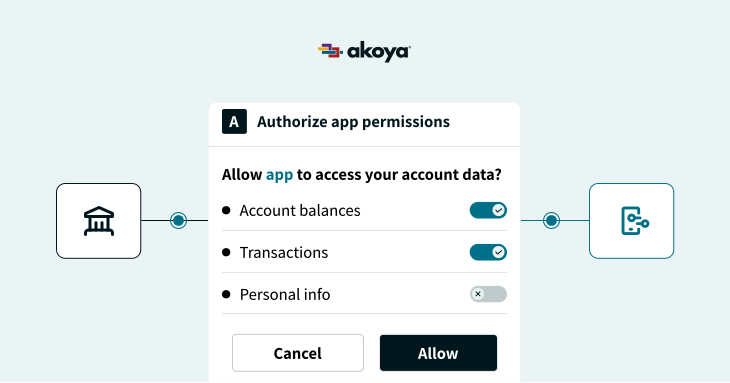
Paul LaRusso: Tech platforms can also help with consent management — how banks ensure the consumer is informed about what they're consenting to, has control over who's getting their data and what's being shared, and can manage that consent on an ongoing basis. These services are available today through partner modules. As a result, banks of any size — from community banks and regionals up to the largest global financial institutions — can now be on the same playing field, offering secure data transfer to their customers. The maturity has grown significantly through partnerships that let banks accelerate implementation.
Michael Moeser: Jo, looking at the spectrum from thinking about it, to pursuing, to scaling — from your experience, what separates institutions that are scaling open finance from those that are stalling?
Jo Jagadish: To summarize: organizations reaching scale have been deliberate about the operating model for implementing open finance, and — more importantly — they've actually seen value. It becomes hard to argue against when you see deepening relationships, lower attrition, easier acquisition. Your customers are happier because they know you support them regardless of the channel they use. That creates a very compelling flywheel, and that momentum combined with the right operating model unlocks scale. Where it stalls is when it's hard to get off the ground, when it's treated as a tech-only project, when there's not sufficient risk-side involvement, or when teams are still waiting for regulatory clarity.
Insight 3: Open Finance Is Driven by Growth, Not Just Compliance
Michael Moeser: There's a question from the audience that's a great segue to our next section. The third insight is that open finance is being driven by growth, not just compliance. In the research, institutions' biggest interests in pursuing open finance included the need to remain competitive, improve customer engagement, and expand into new products, services, or markets. When we looked at value creation for business customers, responses included real-time cash management and treasury solutions, improving customer experience, and competing with fintech providers. The audience question is: can you list a few interesting use cases open finance enables, from both the consumer and financial institution perspective?
Paul LaRusso: Happy to kick things off. In the early days, interesting use cases included the holistic view of assets and liabilities — where consumers could see not only what they had with their direct banking relationship, but also their held-away accounts. We also saw many payment enablement use cases. We finally moved away from the days of trial deposits: you can now instantly verify a consumer and enable them to move money in real time, near real time, or same day.
Paul LaRusso: Use cases continue to evolve, particularly in the lending space. Data is now being used to supplement traditional bureau data — so you can underwrite a loan (personal, business, or mortgage) based on cash flow data or transactions in a deposit account. You can identify attributes and score a consumer's behavior, giving more visibility into what the consumer is doing and making it easier for them to go through the loan process and get approved. That's a pretty interesting one.
Paul LaRusso: On the non-retail side, commercial banking use cases are growing — plugins into ERPs, for example. Commercial clients need access to a variety of data so they can plug it into their resource planning tools for billing and invoicing, payments, cash management, or predictive analytics. Even small businesses can now pull in multiple accounts, manage cash flow better, and feed that data into their own LLMs to help with predictions for the end of the month, quarter, or year. Small businesses are capitalizing on held-away data to drive it into their internal tools and make better decisions.
Michael Moeser: Jo, what use cases are delivering real ROI today — either for your organization or for peers you talk to regularly?
Jo Jagadish: Paul covered a great array of use cases across retail and commercial. I'd highlight two that are particularly interesting and where we've seen good adoption and great value. One is the small business space. Small business owners have been working across a variety of different platforms for years — accounting, HR and payroll, insurance services. At TD, we decided we wanted to be the most effective back office for our small business clients, bundling business-adjacent services with their checking account to deliver more value. As part of that strategy, we integrated open finance into our digital banking ecosystem. We're now able to offer forecasting capabilities that small business owners would otherwise pay for through third parties, as well as benchmarking.
Jo Jagadish: So if you're a pizzeria in a certain zip code, you can see how your cash flow benchmarks against other pizzerias in your area — your county, your state — and understand how seasonality affects your business. These benchmarking tools were typically cobbled together from a variety of sources; now they're automated. Our Small Business Insights dashboard has been a great tool. We see fantastic customer engagement, and it's been a way to demonstrate how important the small business segment is to us. It also creates opportunities to talk about expansion: a small business owner can model opening a new location, forecast lending needs, understand capital requirements, and that naturally triggers a conversation with their business banker about deepening the relationship. So we're using insights to give real value to the customer while also finding the right moment to deepen the relationship.
Jo Jagadish: On the retail side, we're seeing strong traction in leveraging open finance to enhance onboarding and account opening — no more trial deposits, a much more seamless experience. And giving consumers a deeper view of their finances, helping them with goal and savings planning — those are use cases that drive real stickiness and engagement from a retail client standpoint.
Michael Moeser: I like that: stickiness, engagement, deepening the relationship. Those use cases clearly support that.
Insight 4: APIs Alone Aren't Enough — Scaling Requires Infrastructure
Michael Moeser: Let's move on to insight four: APIs alone are not enough; scaling requires infrastructure. In the survey, we asked which option best describes your focus — primarily a data user, a data sharer, or a mix. There wasn't one overwhelming answer. When we asked about data sharing methods, about a third said APIs exclusively, while others reported a combination of screen scraping and APIs. Paul, open finance is often framed around APIs, but the reality is much more complex. Why do APIs alone fall short when institutions try to scale, and what else do they really need in their infrastructure?
Paul LaRusso: Simplistically, the API is the ability to transfer data from one company to another. But other services need to be combined with that. First and foremost is consent and authorization from the consumer. It starts with informing the consumer: what they're permissioning, who they're permissioning it to, and how that data will be accessed and used. You need a solid implementation and experience so the consumer gets educated and knows explicitly what information will be shared and for what purpose — and has ongoing ability to see and manage that. That's the front-end layer that enables the consumer experience. The API infrastructure then follows: after the consumer has directed where their information should go, and for how long, you can facilitate that through the connectivity layer.
Michael Moeser: Jo, we have another audience question that's probably right in your backyard: “Our risk and compliance teams are nervous about third-party data access. How do you bring them along without letting risk concerns kill the momentum?”
Jo Jagadish: It's an important question. What has been critical for us — both to deploy initial use cases and to scale — has been bringing our risk, legal, and compliance partners in at the very earliest stage. I'd think about risks in different categories. There's third-party risk management, as Paul mentioned: as you integrate, how do you get comfortable with accelerated third-party onboarding, and what needs to be true on the bank side to implement that? Being really clear about what your risk partners need to see, and implementing an ecosystem that allows you to move quickly, is important.
Jo Jagadish: The other piece is that the architectural patterns of the solution are still evolving — where are we going to build capability, and what does “capability” even mean? It's not just technical capability; it's capacity in operational risk management, in compliance, and in other risk teams. Then, where are we comfortable working with a partner like Akoya to leverage the infrastructure they've built? The risk and overall architecture patterns really need to be thought through. You'll probably start with a limited set of use cases, and as you expand, your risks will evolve. Tollgate that process — you can't solve for everything on day one. That's a trap a lot of people fall into.
Jo Jagadish: Last point on this: even within the risk ecosystem, finding the right industry forums for risk partners to talk with peers implementing this elsewhere is important. There's an awareness and education element. Back in the 1990s, when internet banking and online banking were new, a whole set of risks came with that ecosystem — and we're very comfortable with it being the de facto model today. Bulk of transactions happen online now. So creating industry think tanks and participating in cross-industry dialogue will help risk partners get comfortable because they're seeing their peers get comfortable too.
Insight 5: Trust, Risk, and Control Are the Biggest Barriers to Scale
Michael Moeser: Insight five: trust, risk, and control are the biggest barriers to scale. When we asked survey respondents about the biggest risks or challenges, top concerns were security, regulatory uncertainty, data liability, and legacy technology. Operationally, third-party risk management and establishing data access agreements were key. Trust is emerging as the gating factor for open finance adoption. Paul, what role does consent management and infrastructure play in building trust at scale?
Paul LaRusso: Trust is the most important component, and banks and financial institutions have done such a great job at ensuring they have the right level of trust with their customers. That extends to data sharing. It starts with making sure the consumer is informed about exactly what they're doing — not hiding things in the terms and conditions, not saying the data will be used for one application and then using it for something else. It really begins with education and awareness.
Paul LaRusso: The second piece is informing the consumer about the multiple parties the data may traverse — if there are intermediaries in the flow, ensuring the consumer is aware and comfortable with that. And the third piece is visibility. Leading financial institutions are building some form of dashboard — it could be a security center, a permissions or control setting similar to how consumers see where their credit or debit cards and payment credentials are stored with different merchants. Consumers can now see where their data is being accessed and shared across different applications, toggle things off at any time, or remove applications altogether. That visibility and control is what really builds trust and allows institutions to scale to a broader consumer base.
Michael Moeser: Jo, how are you thinking about data ownership and data liability today?
Jo Jagadish: We spend an inordinate amount of time, material, and resources on onboarding customers and safeguarding their data. When we say we're in the trust business, that customer data is the trust business. There's an immense amount of focus on the bank side in protecting, managing, and keeping that data current. What I'm looking forward to is additional clarity around data liability as this data leaves the banking ecosystem — I believe that's a fundamental challenge for our industry. My hope is that as we get more clarity in the rulemaking process, the questions of liability and ownership become clearer. The customer owns the data, and we want to make sure that data is as secure as possible throughout the ecosystem, but this space still requires further clarification from the regulatory agencies.
Insight 6: The Winners Will Turn Open Finance into Scalable Growth Engines
Michael Moeser: Our last insight — number six: the winners will turn open finance into scalable growth engines. Leaders cite multiple use cases driving interest, from account aggregation and PFM to account verification for funding, account-to-account payments, and ID verification. On the monetization side, third-party partnerships led the responses, though other approaches are also in play. Jo, what does success look like internally when it comes to achieving monetization?
Jo Jagadish: I don't think monetization is a goal in and of itself, honestly. The goal is how we serve our customers — how we provide products and services that keep them with TD and deliver great value. So it starts with: what value are we meeting, and how do we ensure clients feel they get the best service in terms of feature functionality from the bank? Monetization, revenue, and deepening follow from that. Value creation can mean partnering with a fintech to create an experience that sits outside the TD ecosystem — commercial banking ERP integration is a great example. We've launched capabilities for payment initiation from an ERP system, which delivers value because that's where a lot of our commercial clients' business processes live. But we also see value in bringing third-party relationships into the TD ecosystem, and we've launched several of those initiatives. It really has to start and end with the value we're generating and meeting our customers where they are.
Michael Moeser: That makes sense. Paul, last question on this slide before final thoughts: what monetization models are proving viable across your clients?
Paul LaRusso: Financial institutions are thinking about it through the lens of how they continue to provide value and protections for consumers. Are there services or use cases in the ecosystem that might require additional investment? One example: in the payment ecosystem, if a consumer uses open banking to facilitate payments and there are disputes associated with those payments, there may be costs and services required to make the customer whole and continue to protect them. So some financial institutions are exploring whether to monetize certain relationships between a bank and a third party to put that cost and value back into the experience, to better protect the consumer and ensure a great experience throughout the flow.
Final Thoughts and Recommended First Steps
Michael Moeser: For our last slide, we asked how institutions plan to expand their open finance capabilities. A fair number said they'll be expanding within the next six months — about a third — and another quarter said within seven to 12 months. So about 60% intend to grow, which aligns with the strong priority signal we polled earlier. That said, despite the intent, many don't yet have a defined timeline, and this varies by institution type, with regional banks having more defined timelines. Jo, from a bank's perspective, what's the first step institutions should take tomorrow?
Jo Jagadish: I'll go back to where I started: the direction of travel is fairly clear. Whether you're a regional bank, a GSIB, or a community bank, there's no doubt this is where customer preferences have evolved to — not “are evolving,” but have evolved. My suggestion to banks still thinking about where to start: identify the first use cases that are incredibly valuable for your business, and don't wait for regulatory clarity to be the only moment you begin. There is a lot of groundwork that can be done today. There are great tools in the ecosystem and great companies ready to partner with banks and support them in building this strategic asset. Now is the time.
Michael Moeser: Paul, what should a practical roadmap look like over the next 12 to 24 months?
Paul LaRusso: Three things come to mind. First and foremost, organize around the consumer and get yourself internally aligned. As Jo said, leadership and ownership matter — you have to view this as an additional channel and make sure you have the right organizational setup. Second, think about this as a holistic program. It's not just the technical build of endpoints and data sets; it's consent, third-party management, ongoing version control, TPRM, and TPO. Think holistically. Third, reach out and engage with partnerships. There are great leaders in this space who have matured on this landscape, and a lot of opportunity to help financial institutions accelerate their own journey.
Michael Moeser: That's all we have for today. I want to thank Jo and Paul for the conversation, and thank our audience for joining and asking questions. If we didn't have an opportunity to answer your question, we'll follow up shortly. Thank you, everyone — and thank you again, Jo and Paul.
-1.svg)