

Why financial institutions that move now will define the next decade, and why waiting is no longer a neutral choice.
Open finance has crossed a threshold. What began as a regulatory discussion has become a market force shaped by consumer expectations, competitive pressure, and the hard realities of a financial ecosystem that is re-platforming data. Banks and credit unions that recognize this moment for what it is (a strategic inflection, not an administrative task) are already building the capabilities that will define the next decade of customer relationships.
Akoya's Open Finance Solution gives financial institutions the complete platform to do exactly that: a secure, standards-based foundation and expert managed services that remove the burden of operational complexity, freeing institutions to focus on customers rather than infrastructure.
The market has shifted
Open finance is no longer a horizon item on a multi-year technology roadmap. It is happening now, in your customers' wallets, on their phones, and across the applications that increasingly mediate their financial lives. Open finance has already reshaped the competitive landscape. What remains open is whether your institution will lead it or find itself navigating one that others have designed.
Consumer behavior has already moved
Nearly nine in ten Americans report using fintech apps and services today, up 30% from just a year ago1, driven by explosive growth in digital payments and investing tools. Your customers are already connecting their financial data to third-party applications. They are doing it today, with or without a program you control.
What they want is the ability to share their data securely, with transparency and control, within an experience that reflects your brand and earns their trust. What many are experiencing instead is credential-sharing, screen scraping, and the security vulnerabilities those practices introduce. The institution that solves this problem elegantly earns a deeper, more durable relationship.
|
89% |
77% |
66% |
Source: Plaid, "Open Finance for Financial Institutions," 2025
The window of differentiation is open, but narrowing
Only 52% of U.S. banks offered data-sharing APIs as of 2025.2 That means nearly half of the market has not yet built the infrastructure to participate meaningfully in open finance. For institutions that move now, the opportunity to establish clear differentiation is real and measurable. For those that wait, the structural lead that early movers are building will only widen.
Early evidence is compelling: institutions that have built robust open finance programs are seeing measurable returns. Mastercard's 2026 State of Open Finance report found that 75% of finance executives globally say open finance initiatives have directly grown their organization's revenue. Institutions investing in API infrastructure report a 29% reduction in third-party onboarding time and a 70% improvement in customer retention rates attributed to personalized, data-driven services.3
Global markets confirm the trajectory. In the UK, 1 in 5 adults used open banking in 2025.2 North America is forecast to grow at a 21.4% CAGR through 2027. The global open banking market is projected to reach $386 billion by 2036.4 The institutions building now are positioning for that expansion.
The strategic opportunity: four dimensions
Open finance creates value across four interconnected dimensions. The institutions capturing the most return are moving on all four simultaneously.
Customer trust and loyalty
Screen scraping puts consumers at risk and erodes the trust institutions have spent decades building. A well-executed open finance program flips this dynamic: by giving customers visibility and control over their data sharing from within your own digital experience, your institution becomes the trusted steward of their financial identity. Customers who trust their bank with data are more likely to consolidate relationships and resist competitive attrition.
Intelligence and competitive advantage
Open finance, properly instrumented, generates a continuous signal about what your customers want before they ask. When a customer connects to a competing lender, they may be shopping for credit. When they connect to an investment platform, they may be ready to diversify. These signals arrive before any product conversation. Institutions that build this intelligence infrastructure early create behavioral operating leverage that latecomers cannot quickly replicate, as first-mover data becomes pattern recognition, and pattern recognition becomes predictive accuracy.
Ecosystem position and network effect
API call volume is projected to grow from 137 billion in 2025 to 722 billion by 2029.5 That traffic flows to institutions with the best infrastructure. Fintechs are accelerating partnerships with institutions that offer high-quality, reliable data access, and routing around those that cannot. Every partnership established now is a network effect that raises your institution's value to the next fintech seeking a data provider.
Revenue and economic upside
Leading financial institutions increasingly recognize that secure, permissioned data access requires infrastructure, governance, security, and operational investment. As a result, many institutions are evaluating models to recover those costs while continuing to enable consumer-directed data sharing. Beyond cost recovery, data-first institutions report revenue growth up to five times higher than peers.6
Mastercard's research estimates companies are missing an average of 4.6% in annual revenue because they cannot access necessary consumer permissions.3 For a regional bank with $1 billion in revenue, that represents an estimated $46 million in identifiable upside.
|
75% |
4.6% |
5x |
Sources: Mastercard, "2026 State of Open Finance Report"; ABA Banking Journal / The Financial Brand, April 2026
Why building in-house carries hidden costs
When financial institutions consider their open finance options, the build-versus-partner question comes up early. The appeal of building in-house is understandable: full control, proprietary infrastructure, no vendor dependency. The reality is more complicated.
Open finance is deceptively complex. The surface requirement of exposing customer data via APIs obscures a sprawling operational and technical program that touches nearly every department in the institution.
A genuine open finance build requires:
- FDX-compliant API development and continuous maintenance as standards evolve
- Consumer consent management with full transparency, revocation, and audit trails
- Third-party onboarding, certification, and ongoing risk management
- A developer portal with documentation, sandbox, and support infrastructure
- Real-time monitoring, security operations, and incident response
- Legal agreements drafted and administered for every data recipient
- Dedicated vendor management, compliance reporting, and audit readiness
Each element requires specialized expertise that is scarce and expensive, demanding multi-year timelines, multi-million-dollar investments, and ongoing staffing across engineering, risk, legal, and support. Akoya's internal research puts the upfront cost at over $8 million, with $6 million or more per year to maintain.7 And then the standards evolve, requiring continuous reinvestment simply to stay current.
Every engineering cycle spent on open finance infrastructure is a cycle not invested in the customer-facing innovations that differentiate your institution. Akoya's Open Finance Solution deploys in weeks, not years, letting institutions get operational quickly and start building the data, relationships, and intelligence that create durable operating leverage over time.
Governance, control, and strategic flexibility
Many financial institutions already work with data aggregators, and those relationships are not inherently at odds with a strong open finance program. The more important question is not whether aggregators are present in your ecosystem, but whether your institution has the governance infrastructure to manage them on its own terms.
Without a dedicated open finance platform, institutions often have limited visibility into which third parties are accessing customer data, under what agreements, and with what security posture. Data flows in ways that are difficult to audit, and the institution has little practical ability to respond quickly when a connection needs to be reviewed or revoked.
Akoya gives institutions the infrastructure layer they need to govern that ecosystem deliberately. Every connection is documented, contracted, and visible from a single platform. Every third party is vetted before they reach production data. Consent is managed within your digital experience, not delegated to a third party. That governance layer is valuable whether you work with aggregators, fintechs, or a combination of both, because it means your institution is in control of the data sharing program, not simply a participant in someone else's.
The operational risk of doing nothing
The absence of a modern open finance program is an active risk posture that exposes your institution to fraud, credential compromise, regulatory scrutiny, and reputational damage every day it continues.
Credential exposure and fraud
Where API-based data sharing infrastructure is not in place, screen scraping remains a common practice that requires consumers to share their banking login credentials with third parties. Those credentials are stored outside your institution's visibility, governed by agreements your customers signed without your involvement, and protected by security standards you cannot audit.
The consequences are material. Credential exposure creates direct fraud risk: stolen login credentials are among the most common vectors for account takeover. And when a breach occurs, your institution bears reputational consequences even if the breach originated with a third party. IBM's 2025 research puts the average total cost of a financial data breach at $5.56 million.8 That figure does not include the longer-term cost of eroded customer trust.
Screen scraping also generates operational strain that is often invisible until it becomes a crisis. Industry research suggests up to 53% of a bank's online traffic can originate from bots and scraping activity, overwhelming authentication systems, degrading platform performance, and creating false signals in fraud detection systems that were not designed for that volume.9
Audit readiness and vendor governance
A mature open finance program requires documented oversight of every third party accessing your customers' data: who they are, what they are accessing, under what legal terms, and with what security posture. Without that infrastructure, institutions face examination risk. Regulators increasingly expect demonstrable third-party risk management, and institutions without audit-ready documentation are increasingly exposed.
Akoya's managed services address this directly. Every third party accessing your data through Akoya has been vetted through a risk assessment aligned to NIST CSF and regulatory standards. Every data access agreement is documented and stored in the Admin Console. Every API interaction is logged with complete auditability and traceability. When examiners ask who is accessing your customers' data and under what terms, you can answer with precision, because Akoya runs that program on your behalf.
Akoya’s Open Finance Solution: the platform and managed services
At its core, Akoya's Open Finance Solution is a technical platform combined with expert-managed services. Together they give financial institutions a secure, standards-based open finance capability that is fully operational, without the cost or complexity of building it themselves.
The technical platform
Akoya's platform is white-labeled and FDX-compliant, sitting within your existing customer experience under your brand. It provides the core infrastructure for secure, standards-based data sharing:
|
Component |
What it does |
|
Developer Portal |
A white-labeled, FDX-compliant portal for third-party discovery, testing, and secure onboarding. Third parties manage their own profiles, teams, and applications without requiring involvement from your team. |
|
Admin Console |
A single platform for complete visibility into every authorized third party, application, and due diligence workflow. API usage reporting, real-time connection control, and a full audit trail of signed agreements, all in one place. |
|
Permission Dashboard |
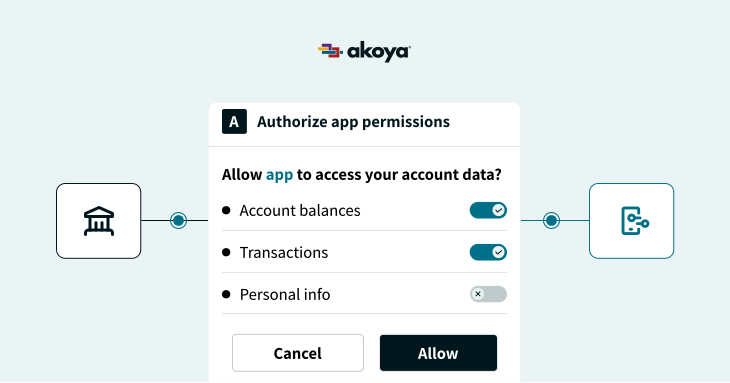
Consumer-facing consent management embedded directly in your mobile or online banking experience. Customers can review, add, or revoke access at any time, without leaving your platform. Available as white-labeled assets or via API if you already have a dashboard. |
|
API Documentation and Sandbox |
Branded developer docs, test users, and a sandbox environment for fast, secure third-party integration. Documentation stays current as your APIs evolve. |
Managed services
Akoya combines the technical platform with six fully managed service pillars, so your institution leads in open finance without running the operations yourself:
|
Service |
What Akoya does for you |
|
Security and Risk Assessments |
Context-based third-party vetting, risk tiering, annual recertification, and continuous monitoring aligned to NIST CSF and regulatory standards. Risk scrutiny scales to the level of access requested: low-risk recipients move quickly; high-risk recipients receive the full assessment. |
|
Data Access Agreement Services |
Akoya drafts, administers, and stores standardized legal agreements between your institution and data recipients. Third parties sign through DocuSign before they ever reach production data. Your legal team stays out of routine contracting. |
|
Strategic Third-Party Onboarding |
Akoya identifies, engages, and manages the full onboarding workflow for your highest-priority data recipients. Joint project plans, recipient-specific issue logs, and three-party calls to resolve integration blockers before go-live. User migrations from legacy connections to secure API-based access are fully coordinated. |
|
Dedicated Relationship Management |
A dedicated Customer Success Manager accountable for your program's performance. Quarterly Business Reviews, proactive analytics, roadmap input sessions, and change request management keep your program moving forward, not just running. |
|
FI Lifecycle Management |
FDX versioning, disaster recovery, penetration testing, and FDX spec compliance are fully owned by Akoya. When standards evolve, Akoya absorbs the work. Your team never plans a project around keeping the platform current. |
|
Responsive Third-Party Support |
24/7 Level 1 support for every authorized third party, covering onboarding, troubleshooting, incident response, and general inquiries. P1 response time: 30 minutes. A tiered escalation model means your institution is only engaged when an issue genuinely requires your involvement. |
Open finance at scale
What separates a successful open finance launch from a prolonged one is not just technology, but the network. When fintechs, aggregators, and data recipients are already integrated with your infrastructure provider, migrations that would otherwise take years can be completed in weeks. Because the Akoya network serves more than 4,500 financial institutions and is already connected to the third parties your customers use, the ecosystem does not have to be built from scratch; it is ready to activate.
The results below are drawn from institutions that have already made this transition. They reflect what becomes possible when an institution deploys a network that the open finance ecosystem has already adopted.
|
|
Why Akoya
Akoya is the infrastructure layer built by the industry, for the industry: not a fintech building products on top of your data, and not a participant in the ecosystem we help you govern. Every connection on the Akoya network is API-based, with no screen scraping, no credential storage, and no third party holding your customers' login credentials in a system you cannot audit. This is a structural characteristic of how Akoya was built, and the security, compliance, and audit benefits flow directly from that design.
Akoya is owned by some of the largest financial institutions in the United States. That ownership means our product roadmap is shaped by the institutions most exposed to open finance risk and opportunity; our standards are calibrated to what tier-one institutions require, and our interests are aligned with yours. We succeed when your open finance program succeeds.
-
The network is already connected: Serving more than 4,500 financial institutions, the Akoya network is live and already integrated with the fintechs, aggregators, and data recipients your customers use. Deploying Akoya activates that network. You do not build connectivity from scratch.
-
100% API-based, by design: Every connection is API-based by design. It is not a selectively applied policy, but the foundation of Akoya’s architecture. As a result, the security, compliance, and audit benefits are built in.
-
Owned by the institutions it serves: Akoya is owned by some of the largest U.S. financial institutions. Our standards reflect what tier-one institutions require. Our roadmap is shaped directly by the institutions we serve.
-
One partner, one contract: Open finance cannot be assembled from point solutions. Akoya delivers the complete program under a single contract, with one partner accountable for the technical platform, all six managed service pillars, and your program's ongoing performance.
Open finance, fully activated
Open finance is not a future state; it is the present condition of the financial ecosystem your customers already inhabit. The question for every financial institution leader reading this paper is not whether to engage, since your customers have already made that decision, but whether that program runs on your terms, with your brand, your data governance, and your customer relationships at the center.
The case for moving now does not rest on regulatory deadlines; it rests on competitive dynamics that are already in motion. The programs being built today produce data advantages, ecosystem relationships, and institutional knowledge that build on themselves, and fintech partnerships established early become loyalty anchors. Every month of delay is a month in which screen scraping continues, credentials are held by parties outside your governance, and competitors extend a lead that requires sustained effort to close.
The institutions that define the next decade of financial services will be the ones that recognize open finance as a strategic asset and build the infrastructure to activate it. They will know more about what their customers need before their customers ask, attract the fintech partners that deliver the most compelling experiences, and build trust that makes customers consolidate relationships and resist competitive attrition. They will also generate revenue through direct monetization, better retention, and data-driven growth, funding the next round of innovation.
With Akoya, the path is well-mapped. The platform has been deployed across institutions of all sizes, the integration process works with existing technology stacks and typically completes in weeks, and the network is already running, all through one partner, one contract, and one complete program.
Download a PDF version of this article.
Learn more about Akoya's Open Finance Solution: akoya.com/openfinance
Explore more open finance resources and content.
References
1 Plaid, "Open Finance for Financial Institutions" whitepaper, 2025. plaid.com/open-finance-whitepaper
2 SQ Magazine, "Open Banking Adoption Statistics 2026." sqmagazine.co.uk
3 Mastercard, "2026 State of Open Finance Report."
4 Future Market Insights, "Open Banking Market Forecast and Outlook 2026 to 2036," January 2026.
5 Plaid, "10 Fintech Trends Defining the Industry's Future in 2026," February 2026. plaid.com
6 ABA Banking Journal, "How Leading Banks Are Enhancing Customer Engagement Through Financial Data Insights," April 2026; The Financial Brand, "Why Banks Are Leaving Revenue on the Table with Open Finance," April 2026.
7 Akoya, internal analysis, 2026.
8 IBM, "Cost of a Data Breach Report 2025." ibm.com/reports/data-breach
9 Thales, "2026 Bad Bot Report," April 2026.
10 Akoya, network and program data, 2026.
11 Akoya, customer program results, 2025–2026.
-1.svg)