

Leading financial institutions understand that open finance creates real value only when data-out is treated as a strategic capability, not a compliance requirement.
Open finance in the U.S. has reached meaningful scale. Over the last decade, more than 100 million Americans have chosen to share their financial data, over 114 million accounts are connected through the standardized FDX format, and tens of thousands of applications have been built on that foundation. The infrastructure exists, the volumes are significant, and the use cases are expanding rapidly.
But scale alone does not create value. Inside most financial institutions, open finance is still framed as a compliance discussion, one defined by the CFPB's Section 1033 rulemaking. That framing leaves the most significant opportunities untouched.
The real opportunity lies beyond the APIs. Leading financial institutions have recognized that data-out is not a compliance requirement to be managed, but a strategic capability to be built. That shift in thinking is where the real value of open finance is actually unlocked.
Data-out is the customer trust engine
Start with the customer.
In the old model, screen scraping required customers to hand over their banking credentials to third-party apps. From the customer’s perspective, there was no real visibility into what data was being shared, no easy way to revoke access, and no consent mechanism worthy of the name. From the institution’s side, the picture was just as troubling: no visibility into who was accessing customer data, no relationship with the third party, and no way to manage what was happening.
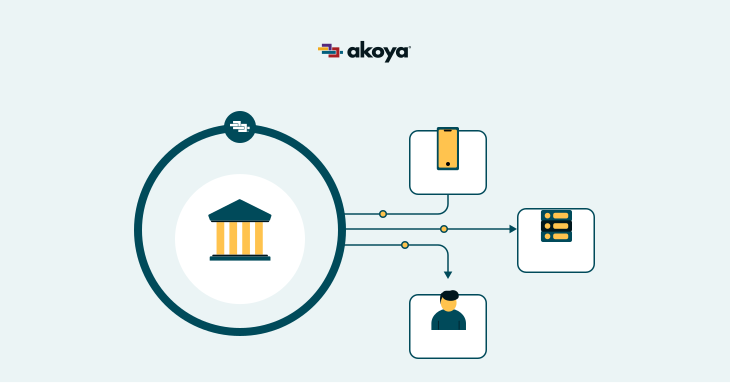
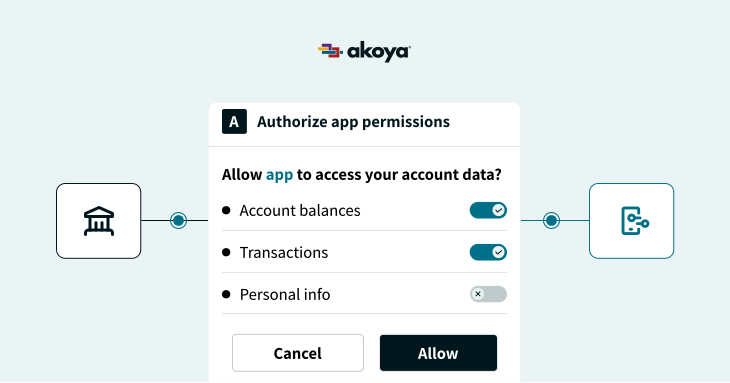
Data-out changes that dynamic entirely. Customers permission their data through a controlled flow. They can see what they shared, with whom, and for how long. They can revoke at any time. Institutions get the same visibility from the other side of the connection.
Trust used to be an abstract claim financial institutions made about themselves. In an open finance world, it becomes something observable and measurable: consent, revocation, transparency, and data minimization, all evident in the data flows themselves.
This is where the role of the institution begins to shift. Rather than protecting customer data by holding onto it, institutions become trusted stewards that help customers share it safely, on their own terms.
That reframing, from gatekeeper to steward, is the foundation that everything else sits on.
“Customers don’t think in terms of ‘open banking.’ They think in terms of control, visibility, and access. When looking through that lens, it was never a compliance conversation and always one about how to deliver the optimal experience to our customers."
— Glenn Stanzione, Vice President & Head of Open Banking at PNC
Data visibility changes everything
Once you accept the trust framing, the second shift follows naturally. Institutions stop thinking about data-out as data leaving them and start thinking about it as insight coming back.
Historically, when a customer used a third-party app linked to their bank account, institutions had no idea. Screen scraping was a black box. The data left, the visibility went with it, and institutions typically found out about the relationship only when something went wrong: a fraud event, a support call, a complaint.
Permissioned, API-based data-out creates a feedback loop that did not exist before. Institutions can see which third parties their customers are connecting to, which use cases are driving the most volume, which customer segments are most active, and where consent is being granted or revoked. That is operational intelligence institutions have never had access to at this scale.
For all the progress made in the U.S., there is a long way to go.
Akoya recently ran a survey with American Banker and the data is clear:
-
only 32% of institutions offer data sharing via APIs exclusively
-
while 54% report operating a mix of APIs and screen scraping.
-
In other words, more than two-thirds of the industry still operate in an environment where some data leaves through scraping.
That gap is where the visibility opportunity lives. Every account migrated from scraping to API is one more data point institutions get back.
“What surprised me wasn’t the volume, it was the patterns," Stanzione said. "Seeing how customers shared data and with whom started informing decisions well outside the open banking team.”
Insight is not a byproduct of open finance. It is one of the primary outputs. Treating it that way changes who needs to be in the room.
The operational reality
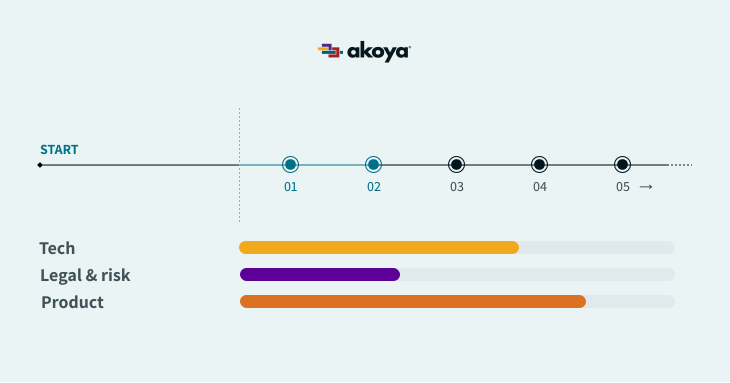
Open finance programs stall when they are treated as plumbing or as a compliance checkbox. The work cuts across product, risk, legal, customer experience, marketing, and finance. It is an operating model shift, not a technology project.
What we consistently see across institutions is that the technical lift is rarely the blocker. It is the operational overhead: third-party vetting, contract management, monitoring, and cross-functional coordination that slows everything down. Data-out becomes strategic only when those pieces are standardized and repeatable. That is the gap Akoya was built to close: absorb the operational complexity that otherwise stalls progress, so financial institutions can focus on the strategic decisions only they can make.
This will not be friction-free. The same American Banker survey asked institutions about their biggest open finance challenges.
The top three:
- 49% cited security and data privacy concerns
- 41% cited regulatory uncertainty and complexity
- 37% cited data liability in the event of a breach or fraud
Notice what is not on the list: technology. The hard problems are governance problems.
Third-party risk management is a particularly instructive example. In the screen scraping era, institutions had no relationship with third parties accessing their data. In the new model, there is a formal program, formal vetting, and a real accountability structure. That is a meaningful improvement, but it brings operational overhead worth planning for.
This is precisely the kind of work that benefits from a network model, where third-party vetting can be done once and trusted across many institutions.
How data-out drives real growth
Trust earns the right to play. Insight tells you what to do next. Growth is what data-out actually unlocks once those two are in place.
The real upside of open finance is not efficiency. It is relevance.
Data-out becomes the foundation for things that were previously difficult or impossible:
- Smarter personalization: a full view of where customers are active, not just activity within their own walls, enables more tailored and relevant experiences.
- Ecosystem partnerships: institutions can identify and respond quickly to new use cases (e.g., PFM, lending, payments, identity verification).
- Better fraud controls: permissioned data flows replace credential sharing.
- Reduced operational risk: institutions know who is accessing what, and when.
- Stronger customer engagement: customers return to the institution that makes their financial life work, not the one that locks data away.
Financial services leaders are already signaling where demand is heading. The American Banker survey ranked the top use cases driving open finance investment: account aggregation and PFM at 47%, account verification and funding for account opening at 43%, account-to-account payments at 41%, identity verification at 35%, embedded finance at 32%, and alternative lending models like cash flow underwriting at 32%.
That is a broad surface area. No institution is going to win all of those use cases on its own. The institutions that get this right are the ones that recognize they are not simply enabling a data-out strategy. They are earning a seat at the table of a larger ecosystem.
“By always focusing on what is best for our customers, we have viewed data-out as an opportunity, rather than in terms of cost or compliance,” Stanzione said.
That is the shift. From data-out as a cost to data-out as a capability.
Don’t wait for regulatory certainty to act
The business case is already here.
Open finance gives institutions a concrete path to deeper customer engagement, better experiences, and more personalized services. It is what allows an institution to become a trusted steward of its customers’ financial identity, offering a secure, transparent, and revocable way to share their data and benefit from it.
The progression is straightforward. Institutions that move now will build a meaningful head start as the ecosystem continues to evolve. Those that wait will spend the next several years catching up to peers who treated data-out as a strategic capability rather than a compliance obligation.
That gap will be hard to close.
This is a leadership decision. The infrastructure exists, the use cases are proven, and the competitive dynamics are already in motion. The only real question is whether your financial institution shapes what comes next or responds to it.
________
Ready to take the next step? Akoya partners with financial institutions of every size to deliver secure, API-based open finance infrastructure, from consent and third-party management to the connectivity layer itself.
Learn more about Akoya’s Open Finance Solution or get in touch to talk through what a practical roadmap looks like for your financial institution.
-1.svg)